

The Most Expensive Worker in the Office Isn't Human!
How compute costs are complicating the fantasy of mass AI replacement!

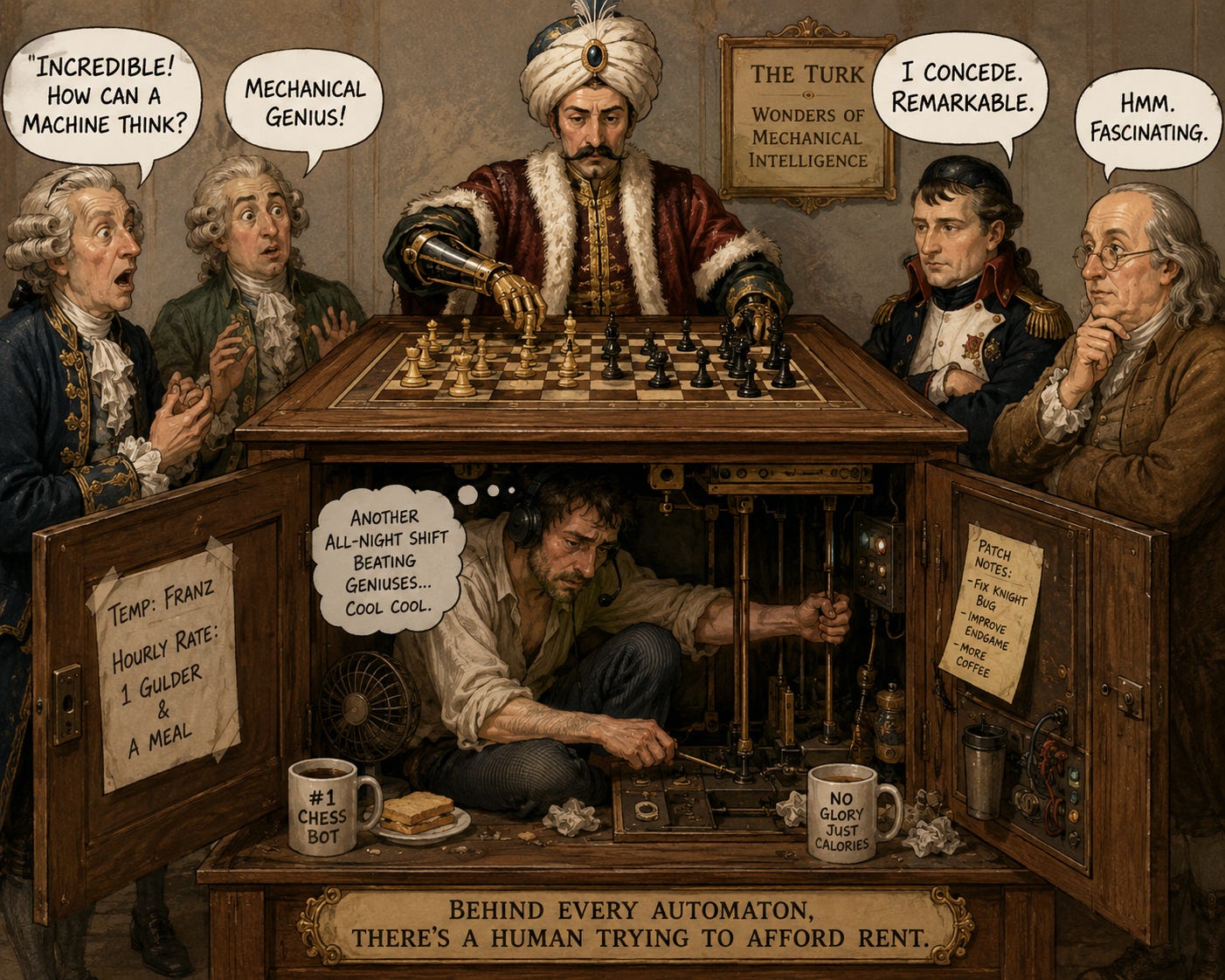
In 1770, a crowd gathered in Vienna to watch a machine perform miracles.
The machine was called The Turk. It was a chess-playing automaton, a wooden cabinet dressed in Ottoman robes with a mechanical arm that moved pieces across the board. It was built by a Hungarian inventor, Wolfgang von Kempelen, to impress Empress Maria Theresa.
People lost their minds over it. Napoleon played it and lost. Benjamin Franklin played it and lost. Two of the most formidable minds of the eighteenth century got beaten by a wooden box in Ottoman robes. Newspapers breathlessly described the mechanical genius that would surely reorder civilization.
There was only one problem.
The automation revolution required a tired human folded like laundry beneath the table.
Three centuries later, we appear to have learned absolutely nothing.
Which brings me to the thing I have been saying for years.
The “AI will replace everyone” story has a serious math problem. Because intelligence at an industrial scale is not cheap. And increasingly, the compute bill is looking more expensive than the humans everyone keeps threatening to replace.

Hi, I’m Neela,
Today, I am writing about AI, compute costs, and the stages of grief tech executives go through when the invoice arrives.
I am a COO in the tech industry. I have been saying this for years. I have the receipts. So does Uber's CTO apparently, and his were considerably larger than expected.
This newsletter exists because someone who actually runs things should probably weigh in.

Stage 1: Denial
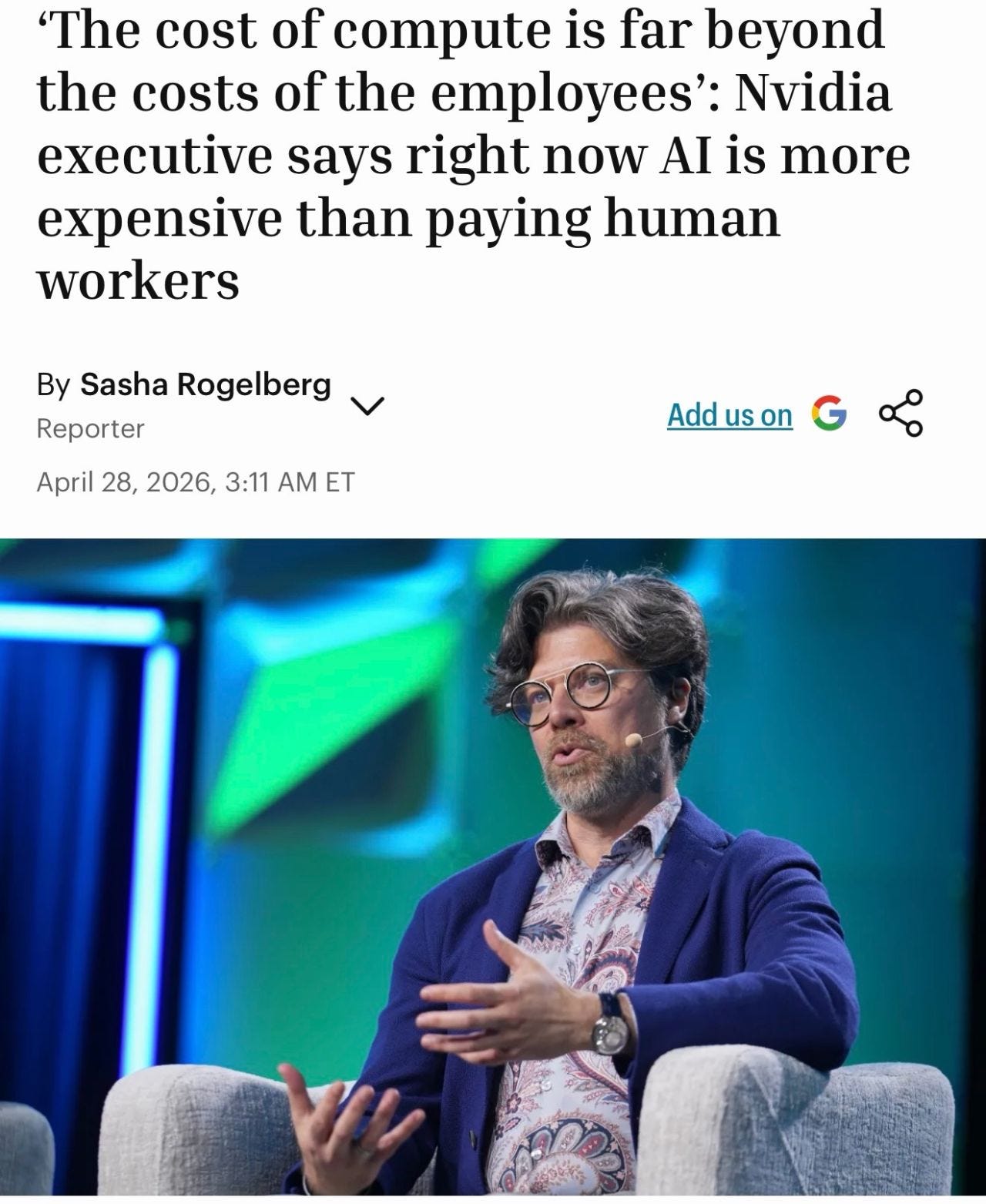
Bryan Catanzaro (pictured above), Nvidia’s VP of Applied Deep Learning, recently admitted that for his team, “the cost of compute is far beyond the costs of the employees.”
That sentence should have landed like a bowling ball on a glass coffee table.
Instead, it floated through the news cycle like elevator music. Probably because “AI apocalypse delayed by utility invoice” is not quite as cinematic as killer robots.
Still, here we are.
Catanzaro is not alone. Uber’s chief technology officer, Praveen Neppalli Naga, told The Information that he had already burned through his company’s entire 2026 AI budget on token costs — and the year was not halfway done. “I’m back to the drawing board,” he said, “because the budget I thought I would need is blown away already.”
Uber, for context, is a company that runs on software and scale and has been evangelizing AI cost savings for years. Their CTO ran out of budget before summer.
One more thing worth noting before we move on. You know those announcements tech companies keep making about laying off humans because of AI? The ones where the press release says something about efficiency and the future of work and the bold decision to right-size for an AI-first world?
This is what they have in their heads when they say that. Uber’s CTO spent $1,200 in two hours on a personal demo session. The average laid-off engineer costs about $83 an hour fully loaded.
Do that math slowly.
Stage 2: Overclaiming
A few years ago, tech executives spoke about computing the way medieval kings spoke about dragons. Mysterious, expensive, but manageable if you hired enough wizards.
Now, the computer has become the central character in the story.
That’s a stunning reversal for an industry that spent forty years worshipping labor efficiency. We built entire corporate religions around reducing headcount. The spreadsheet was king. Every quarterly earnings call was mainly a polite hostage video explaining why fewer humans somehow meant “innovation.”
Then AI arrived and said something like….
“Actually, we’re going to need billions in GPUs, specialized cooling, fiber interconnects, backup power systems, and enough electricity to restart the sun.”
Whoops!
Stage 3: Bargaining
Recent industry estimates show compute now represents between 54 and 62 percent of spending at leading AI companies. At Anthropic alone, estimates place 2025 compute spending near $6.8 billion. Staff costs were materially lower.
The public still imagines AI like a one-time construction project. Train the model, plug it in, fire the humans, cue dystopian soundtrack.
Reality looks very different.
Research shows inference costs dominate the lifecycle economics of AI systems. According to industry analysts including Gartner, companies routinely underestimate inference costs by 500 to 1000 percent when scaling AI, and for the first time in 2026, inference spending surpassed training as the largest single AI cost category.

I’m glad you asked!
Inference is the running cost as opposed to the building cost. You pay once to train the model. You pay forever to operate it. The more people use it, the more it costs. Success in AI economics is expensive in a way that success in most other industries is not.
And unlike human workers, inference does not become cheaper because morale improves after pizza Friday.
Every prompt costs money. Every AI-generated image of a Victorian squirrel wearing Oakleys costs money. The internet has accidentally created millions of people who now use a billion-dollar infrastructure to produce LinkedIn posts announcing they are “humbled and honored.”
Imagine explaining this to Nikola Tesla.
“Sir, we have harnessed planetary-scale computation.”
“Incredible. Are you curing disease?”
“Well… some of it is helping marketing managers rewrite emails in a more synergistic tone.”

There is a reason data centers resemble hydroelectric empires. McKinsey estimates the global race to build AI-ready infrastructure may approach $7 trillion by 2030.
Meanwhile, Gartner projects worldwide IT spending will hit $6.31 trillion in 2026, up 13.5 percent from last year. Big Tech has announced $740 billion in capital expenditures this year alone, according to Morgan Stanley, a 69 percent increase from 2025. The Yale Budget Lab, for its part, has found no widespread data to support the idea that AI is displacing jobs at anything like the predicted scale.
Now, before the AI faithful accuse me of becoming a nostalgic monk typing manifestos on a typewriter, let me be clear.
AI absolutely changes labor markets. So did spreadsheets. So did forklifts. So did the cotton gin, container shipping, ATMs, and Excel macros that eliminated entire generations of accountants’ will to live.
Technology reshapes jobs. That part is true.
But replacement economics are never as simple as futurists pretend.
During the 1960s, experts predicted fully automated kitchens by the year 2000. Instead, we got DoorDash and a microwave that still leaves one frozen ravioli in the center like a tiny iceberg.
Why?
Because labor is often astonishingly flexible and cheap compared to infrastructure. Humans can improvise. Humans can absorb ambiguity without requiring another $40 million server rack. To replicate that fluidity artificially requires layers upon layers of expensive orchestration.
And then somebody still has to call Linda from accounting because the AI accidentally refunded a human in Ohio.
Stage 4: The Budget Meeting
Boards love the fantasy of replacing payroll with software because payroll is emotionally visible. You see people. You know their salaries. Humans sigh audibly in meetings.
Compute costs are sneakier.
They hide inside cloud invoices, depreciation schedules, energy contracts, networking overhead, cooling infrastructure, inference spikes, compliance costs, and specialized engineering talent required just to keep the whole circus from catching fire.
An employee taking a coffee break feels inefficient. A GPU cluster idling at 3 a.m. somehow feels futuristic.
But accountants eventually notice. And you know, accountants. They possess the supernatural ability to ruin a story with math. Friggin Linda.
Which is why I suspect the next decade will not belong to companies replacing humans wholesale. It will belong to companies figuring out where humans are still economically superior.
Stage 5: Reframing
The workers who will do well in this environment are not the ones who refused to learn the tools. They are the ones who learned the tools well enough to know where the tools fail, and who can do the work the tools cannot do, which is the work of deciding what problem is worth solving in the first place.
Nicholas Carr wrote in The Shallows in 2010 that technology changes how we think, not just what we do. The most important effect of AI on knowledge work is reorientation. The work is not disappearing. It is changing shape. And that requires more experienced humans doing it well, not fewer.
Sesame Street explained the operational version of this better than Silicon Valley ever has. There is an old skit where Grover works as a waiter, constantly running back and forth between the customer and the kitchen, growing more and more frantic. Eventually, the joke becomes obvious. The process is absurdly inefficient because one overworked system is trying to do everything.
That is modern enterprise AI. The more successful it becomes, the more expensive the infrastructure often gets. Usage explodes. Demand explodes. Inference explodes.
Which is why the popular image of AI replacing workers overnight feels so detached from operational reality.
Everyone in the room knows the infrastructure costs are monstrous. Everyone knows profitability remains murky. But nobody wants to be the first executive to say that part out loud because Wall Street currently treats “AI strategy” like medieval Europeans treated holy relics. Questioning it risks exile.
Reality has a habit of arriving eventually. Usually, carrying an invoice.
Stage 6: Acceptance
Humans are expensive. Replacing humans at scale is often even more expensive. Especially when your replacement employee requires enough electricity to power a small airport and still occasionally tells customers to put glue on pizza.

That last detail matters more than people think.
Thank you very much for reading.
Smashing that ❤️ button or sharing this post keeps the wheels on this greasy squirrel wheel.
So, when do we complete the circle and companies start rehiring all the people they laid off to replace with AI to save money? Shall we place bets?
We should get a raffle ticket or a medal for watching this trainwreck happen in real-time. This stuff is bananas. That glue on pizza line is just perfect expression of how tech lacks basic human common sense.