

The Problem With Humans Is We Think Everything Is About Us
The Squirrel, the Staircase, and the Man Who Wouldn’t Leave


In April 1918, while American soldiers were fighting through the Argonne Forest in France, California was fighting a different kind of war at home.
Against squirrels.
State horticulture commissioner George H. Hecke published a pamphlet called “Kill the Squirrels,” in which he urged schoolchildren to organize themselves into companies of soldiers and march out to destroy what he called “the squirrel army.”
The pamphlet did not stop at telling children to chase squirrels away. It included instructions for shooting them, drowning them, and using poison gas. There was even a recipe for strychnine-laced grain. And because nothing motivates a child like capitalism, there were cash prizes too.
Fifty dollars to whichever school killed the most squirrels.
A pretty extraordinary incentive for children to participate in what was, essentially, a government-sponsored squirrel killing contest.
They called it Squirrel Week.
I thought about Squirrel Week three Sundays ago when a man I have never spoken to in the two years I’ve lived here walked up the staircase toward my home carrying an iron pole with a sharpened metal tip.
Two squirrels were running ahead of him.
They ran up the path and onto my patio like refugees crossing a border, which, in a way, they were.
I asked the man what he was doing. He said the squirrels were digging holes in his yard and he was going to “deal with them.”
He pointed at the squirrels. On my patio. They were a few feet from my front door.
I told him that squirrels digging holes in the yard was a normal occurrence. It does not give someone permission to approach another person’s home carrying something that looks like it belongs in the movie The Gladiators.
He told me he could do whatever he wanted.
I told him to leave.
He told me the staircase was “not technically private property.” He proceeded to stare at me. That’s when I lost my shit.

Hi, I’m Neela,
Today, I’m writing about a man who beats squirrels to death with iron bars in a planned community in Orange County.
I’m a COO in the tech industry.
I can't promise this article will improve your day. But it might make your neighbors seem reasonable.
How much control do humans expect to have over the natural world around them?
A squirrel digs a hole in your yard. A bee lands on your patio. A raccoon gets into your trash. None of these things are unusual. They are just moments where the natural world bumps into the human one.
The Western relationship with wildlife has long wrestled with the idea of dominion. The language comes from Genesis 1:28, where humans are told to “have dominion over the fish of the sea and over the birds of the heavens and over every living thing that moves on the earth.”
In Hindu texts such as the Earth Hymn of the Atharvaveda, the Earth is described as a mother, placing humans within nature rather than above it.
Over time, dominion was interpreted less as a duty and more as a license. The natural world became something to manage when it was useful and eliminate when it was not.
California’s Squirrel Week was part of that mindset. The squirrels were eating grain that could feed soldiers overseas. The squirrels were vectors for bubonic plague, or so the pamphlets claimed.
The squirrels became the enemy.
Children became the soldiers.
Strychnine became patriotism.
More than a century later, the urge to control whatever bothers us is still there.
The Animals Are Not Here for Us
There is a scene in Werner Herzog’s documentary Grizzly Man where he talks about Timothy Treadwell’s belief that he had a special connection with the bears he lived among.
Herzog disagreed. In his unmistakably deadpan way, he said he did not see friendship in the eyes of the bear. He saw the indifference of nature.
To some extent, I understand what he meant.
Nature does not consider our feelings. It never has. And maybe that is part of what bothers us so much. We expect the world around us to respond to our needs, even when it has no idea we exist.
The squirrel digging a hole in someone’s yard does not understand property lines. It is not trying to annoy anyone.
It is looking for food.
That is all.
They have been doing it for roughly 40 million years, which is longer than humans have been drawing property lines.
Escalation
The pole was not the beginning. Over the past few months, I have watched the man walk through the common areas carrying a fishing rod with bait attached. I have seen him set traps in the yard close to his home. I have seen him spray chemicals in outdoor areas that border common spaces. And yes…a complaint was made to the HOA.
That Sunday was the first time he brought it to my door.
After I politely asked him to leave twice, told him I was recording the interaction on security cameras, and told him to get off my property or I would call 911, he refused to leave.
My husband came outside, and then he left.
Think about that.
A woman tells him NO. He smirks and stays.
A man tells him NO. He bows his head and goes.
If you’re surprised by this, we have different life experiences.
Later that evening, I was outside again. He stood facing me from his area with his arms folded like a creep. I didn’t notice. My husband did.
The folded arms weren’t about squirrels anymore. It was an intimidation tactic.
It was about a woman who had told him NO and meant it.
What Gets Protected and What Doesn’t
Under California Fish and Game Code Section 4181, property owners dealing with native gray squirrels causing damage can apply for a depredation permit through the California Department of Fish and Wildlife.
In other words, there is a legal process. It involves paperwork and oversight. There are rules. Poison is not allowed for gray squirrels. You cannot simply wander around a residential neighborhood carrying a sharpened pole and call it pest control.
For nonnative species like the eastern fox squirrel, the rules are different. But even then, local restrictions still apply. Everything needs to be done humanely.
The point being.
Wildlife management is a regulated thing.
Personal frustration not so much.
I Love Bees Too
When I find a bee struggling on the concrete, I slide a piece of paper underneath it and move it into the shade. I do this because bees are pollinators and the ecosystem needs them. But I also do it because I think about what it must feel like to be small and dying on hot concrete while something enormous and powerful decides whether you matter.
There is no grand environmental impact from saving one bee. It will not change the world. But it will save one bee. And saving one bee, right now, on this patio, on this afternoon, is something I can do. So… I just fucking do it.
That might be the biggest difference between the man with the pole and me. He sees a creature in his space and thinks about how to remove it. I see a creature in my space and think about how to help it survive.
I doubt either of us changed the other’s mind that Sunday.
Who the Staircase Is Really For
The staircase where the squirrels ran is not shared infrastructure. It connects the ground level or the yard to my patio and my front door. The UPS guy uses it to deliver my packages. No one has the right to use the staircase unless they live in my house. It belongs, technically, to the HOA. Which means it belongs to everyone and no one. That kind of vagueness attracts a certain type of person.
“Not technically private.”
In my experience, people who rely heavily on the word “technically” are often people who know they have crossed a line and are searching for a teeny tiny loophole.
The squirrels didn’t know about the technicality. They just ran toward the nearest safe place they could find. They chose my patio. Compliment well-received.
What I Wanted!
I didn’t want this man arrested. I didn’t want him punished, because punishment rarely changes the instinct that produced the behavior.
What I want was simpler.
I want him to consider, just once, that the squirrel digging a hole in his yard is not his enemy. That the natural world is not an inconvenience to eliminate. It is the system we live inside. Whether we acknowledge it or not. The wild animals were here first.
California lost 785 square miles of natural land to development in a single decade. In Southern California, somewhere between 60 and 90 percent of coastal sage scrub habitat is gone.
In Orange County alone, development erases more than two square miles of land every year. More than 300 species in California are at or near extinction. The squirrels are standing on what's left.
Humans spend enormous amounts of energy trying to control nature while spending just as much trying to reconnect with it. Think about it!
We buy books about forests.
We go hiking to escape the hustle and bustle.
We visit national parks.
We share videos of baby animals on social media.
We rent cabins in the woods so we can sit peacefully and listen to birds.
Then we come home and lose our minds when a bird shits on the patio furniture.
We want nature.
Just curated.
Like a streaming service.
Wildlife, but with better settings, you know?
E.O. Wilson wrote in Biophilia that humans have an innate tendency to seek connections with other living things. We are drawn to living things because we evolved among them.
Maybe that’s why some of us stop to move a bee out of the sun.
Maybe that’s why some of us feel something when an animal is hurt.
And maybe that’s why watching someone respond to a squirrel with a sharpened pole feels so wrong.
Because somewhere along the way, this man decided he was separate from the world around him.
I don’t think we are.
I think the squirrels know that.
Thank you so much for reading.
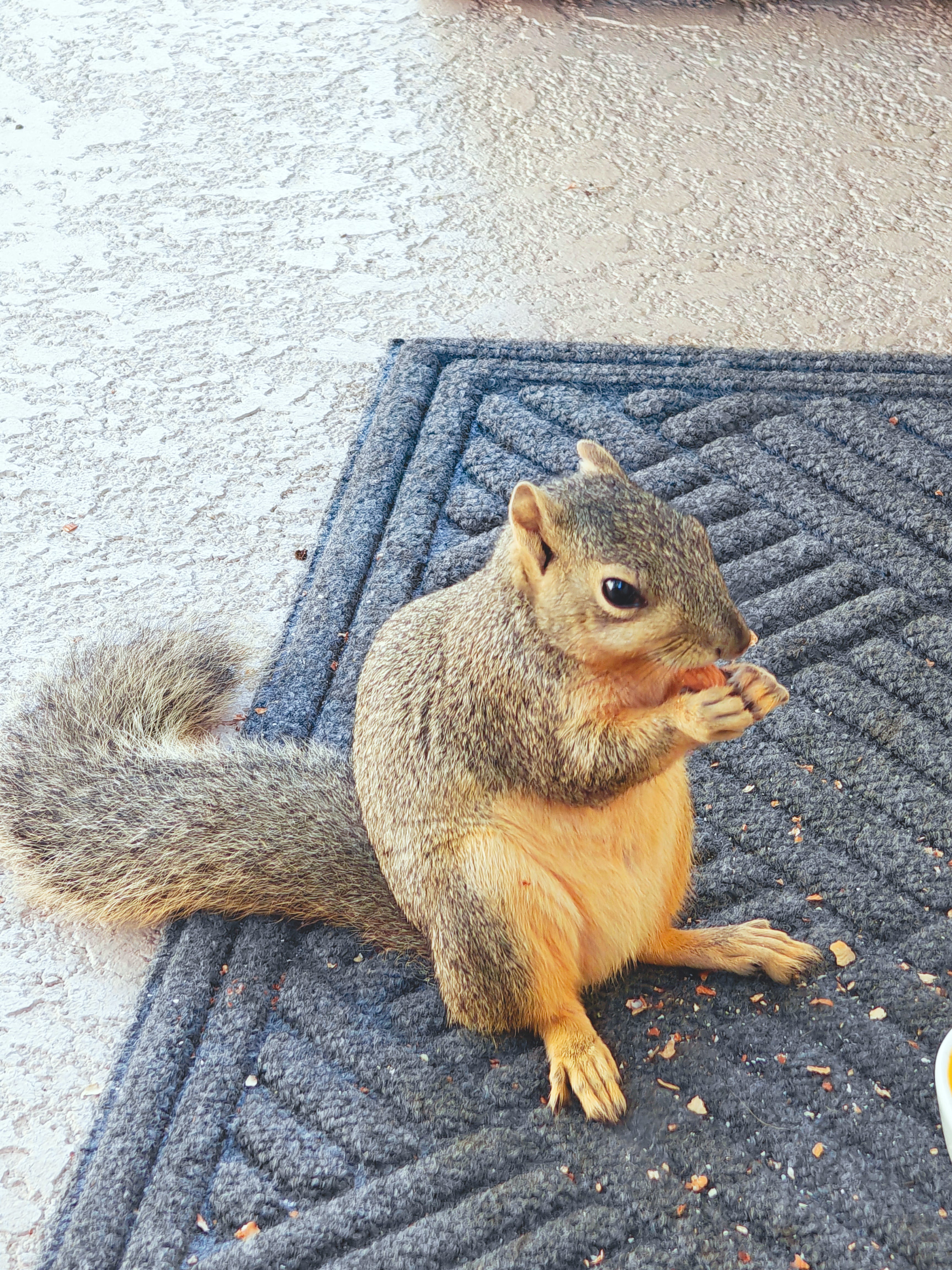
Say hello to Ziggy.
Special thanks to Jennifer Houle for keeping me caffeinated.
A stranger approached your home, brandishing a spear?? I don’t care what the reason is — I would have LOST MY SHIT.
I obviously knew about your love for squirrels, but reading about how you care for the struggling bees made me tear up a little. Neela, thank you for being the goodness balancing out this cruel world. Have a happy Tuesday!
I always feel like people like that are really waging a war against something else, and the squirrel is just a proxy for the larger (possibly internal) fight for them.
How many squirrels are in the area now and how do you keep their names straight???