

The Difference Between Letting Go and Looking Away
Sad Marcelo and the Doctrine of Doing Nothing


He had been hurt. A hawk, probably. Possibly a car. The rehabber I called was careful with her words, which I have learned is what people do when they are trying to be kind about something that does not look survivable. One back leg was not working. He had a head wound I could not fully assess because I was also crying a little.
The wisdom about wild animals is clear. Do not interfere. Let nature take its course. A predator needs to eat, too. The ecosystem is self-correcting. Everything that dies feeds something else.
All of this is true. None of it helped me put the phone down.
The rehabber walked me through what to do. Warmth and sterile saline. Some place quiet. A very specific feeding protocol. Time.
She had seen worse, she said at the end of the call, which I chose to interpret as encouraging rather than as the statistical statement it probably was.
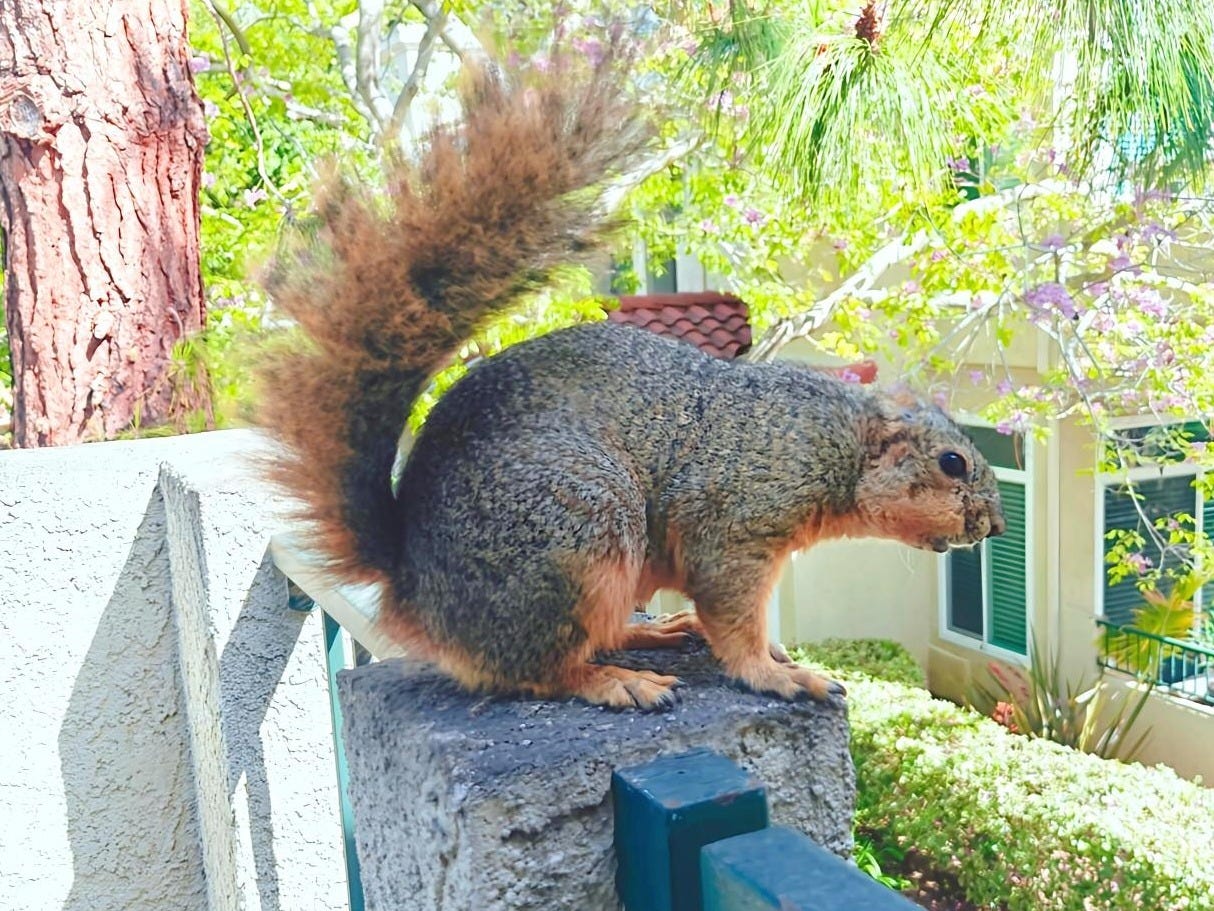
What followed was three weeks of the most unlikely nursing situation I have ever been party to. Sad Marcelo did not die. He was furious about being handled, which the rehabber told me was a very good sign. He ate. He moved. Slowly, then less slowly. The leg came back enough. His head wound healed. He started sitting on my windowsill, looking at me. My husband thinks of all the squirrels in the yard; he has the biggest crush on me. I think he may be right.
So was I wrong to intervene?

Hi, I’m Neela,
Today, I’m writing about why “let it find its own equilibrium” is the most expensive sentence in modern management, and what a wounded squirrel taught me about the difference between patience and avoidance.
Officially, I write about business, technology, and life lessons.
I’m a COO in the tech industry who happens to love wild animals.
This newsletter is my escape hatch. I’m not sure it’ll work.
But it sure beats adding “thought leader” to my LinkedIn profile.

In 1906, Theodore Roosevelt set aside the Kaibab in northern Arizona as a game preserve, with the noble idea that deer should be protected from things that ate deer.
The Kaibab is a high plateau - nearly 9,000 feet of ponderosa pine forest and aspen groves where mule deer had lived in balance with predators for thousands of years. Roosevelt decided to tip that balance.
Between 1907 and 1939, government trappers killed 816 mountain lions, 20 wolves, more than 7,000 coyotes, and over 500 bobcats. The mule deer population, depending on whose count you believe, climbed from around 4,000 to somewhere between 30,000 and 100,000. Then came two terrible winters in the mid-1920s; the vegetation collapsed, and the herd dwindled to a fraction.
The story became a parable. Do not remove the wolves. The mountain knows what it is doing.
It is a tidy fable. It is also somewhat fictional.

In 1970, an ecologist named Graeme Caughley pulled the threads on the Kaibab story and discovered three uncomfortable facts. The population numbers had been guesses on top of guesses, with peak estimates ranging from 30,000 to 100,000 depending on which biologist you asked.
The predator-removal story ignored the simultaneous removal of roughly 200,000 sheep and 20,000 cattle that had been grazing the plateau alongside the deer. And the climate during those years took over part of the job we had assigned to the wolves.
The cautionary tale, in other words, is itself a cautionary tale. We told ourselves a clean story about non-intervention because the real version made us look more confused than we wanted to be.
Aldo Leopold, who wrote about the Kaibab and is the patron saint of “let nature handle it,” knew this. In his 1949 essay “Thinking Like a Mountain,” he describes shooting a wolf as a young man and watching what he called the fierce green fire dying in her eyes.
He spent the rest of his career arguing for restraint. But he also wrote that the deer had eaten themselves out of house and home, and that “too much safety seems to yield only danger in the long run.” Even the man who told us to step back understood that doing nothing is a position. It is not a default, and it is rarely free.
I have spent twenty-five years watching organizations make this mistake in the other direction.
The instinct not to intervene is not always wisdom. Sometimes it is burnout. Sometimes it is conflict aversion with a philosophy bolted onto the front door. The team is struggling. The process is broken. And someone in the room says, “Let it find its own equilibrium,” and everyone nods because that sounds better than admitting they do not want to fix the damn thing.
Sad Data
The data on this is generally unkind. Gallup released its 2026 State of the Global Workplace report this April, and the headline finding is that global employee engagement fell to 20% in 2025, down from a peak of 23% in 2022, marking the first time Gallup has recorded two consecutive years of decline.
In 2024, disengagement resulted in an estimated $10 trillion in lost productivity globally, equivalent to 9% of global GDP.
Cue - R.E.M. - It’s The End Of The World
The interesting part, for our purposes, is what is driving it.
Manager engagement fell from 27% to 22% in 2025 alone, the largest year-over-year drop on record, while engagement among individual contributors stayed largely flat.
This is the Kaibab in a Slack channel. The entire layer that should be intervening, coaching, calibrating, and redirecting has gone quiet. Remove the people who used to do the work of correction, and you get a herd eating its own future while everyone agrees the system will sort itself out.
Add Artificial Intelligence on top of that, and you get Premium Grade Fuckery (a disaster so well-executed it almost earns respect.)
Systems Need Constraints
Donella Meadows, in Thinking in Systems, made the point. Systems can self-organize, but only within boundaries that somebody has to hold. A thermostat does not maintain temperature by accident. Someone built it, set the range, and has to replace the batteries when they die.
Pretending the thermostat is in the room is one of the great managerial errors of the last fifty years. We took a useful metaphor about ecological self-regulation, applied it to companies, and used it as cover for everything from refusing to give feedback to declining to fire the person who has been burning the place down since 2019.
The leaders who do real damage are rarely the ones who roll up their sleeves. They are the ones who intervene loudly on the easy thing and quietly on nothing for the hard thing.
They restructure the org chart and leave the toxic VP in place. They roll out a new performance system and never address the manager who plays favorites. They wrote a values poster and let the bullying continue during the meeting, where it was approved.
The intervention is a theater. The non-intervention is the actual policy. And then they tell themselves they are being patient with the system.
This is the Kaibab mistake, corporate edition: partial interference while pretending to let things self-correct.
Creatures vs. Systems: The Test That Actually Matters
Sad Marcelo did not need a redesign. He needed warmth, saline, and somebody willing to be patient with a small, angry animal who could not feed himself for a while.
The rehabber was very clear about the difference between what an individual creature needs and what a population needs. You do not raise a wild squirrel into a pet. You do not relocate predators because one squirrel got hurt. You provide the specific care that this specific creature needs to get back to the life it was living, and then you let go.
That is the move organizations keep flubbing. They confuse helping a person with redesigning the system. Or they hide behind redesigning the system to avoid helping the person.
The test I have learned to use, after many years of getting this wrong, is whether the thing in front of me is a system or a creature.
A system has emergent properties, feedback loops, and the capacity to self-correct over time if its constraints are sound. You intervene in a system by adjusting constraints, then waiting, then watching, then adjusting again.
A creature has a heartbeat. Creatures do not have time for your philosophy. They need warmth, quiet, and the right protocol, and they need it now.
Most leadership advice treats everything like a system. Most therapeutic advice treats everything like a creature. Both are wrong about half the fucking time.
The skill is telling the difference in the moment, which is harder than any framework lets on, because the same situation is often both at once.
A struggling team is a system. The person on that team who is two missed paychecks from a crisis is a creature.
Treating them the same is how you end up with a company that has beautiful quarterly objectives and a turnover problem nobody wants to talk about.
What “Let It Find Equilibrium” Actually Costs
The squirrel on my balcony rail did not ask for my help. He would, in fact, prefer I keep my distance, lower my voice, and stop narrating his eating habits to people on the internet. But he is alive, which he would not be without a rehabber who knew what she was doing and a person who was not willing to look away.
I do not think that makes me heroic. Heroism is for firefighters and people who answer unknown phone numbers.
I think it makes me someone who understands the difference between a system and a creature, and acts accordingly.
Because in work and in life, we are constantly deciding whether something needs intervention or distance.
A struggling employee. A failing partnership. A parent getting older. A team that has lost its way.
People love rules because rules remove guilt.
Never interfere. Always protect. Trust the process. Fight for what matters.
Wonderful slogans. Terrible operating systems.
Life does not hand out neat choices. It hands you a bleeding squirrel named Sad Marcelo and asks whether your principles still work when they have a pulse.
Leadership is often the same problem.
It asks whether you are protecting the integrity of a system or simply protecting your own comfort.
Sometimes the right answer is restraint. Set the constraints, then step back and let the system self-organize within those boundaries.
Sometimes the right answer is immediate, specific intervention. Warmth, quiet, the right protocol, and someone willing to show up when it matters.
The trick is knowing which is which.
And if you get it wrong, I recommend at least naming the squirrel something memorable.
It helps with writing the article.
Thank you so much for taking the time.
Shout-out to Michelle Singer & Kim Doyal for keeping me caffeinated.
Thank you very much for reading.
Smashing that ❤️ button or sharing this post keeps the wheels on this greasy squirrel wheel.
I love how you highlight both individuals and systems. Tending both of those aspects is vital, interrelated, and mutually changing. It requires both skills and artistry, and I appreciate how you address a third component - the mentors and guides who step back to think about various responses before getting mired in concrete. I also think your lateral thinking (what can I learn about management systems from national parks?) opens our minds to wider possibilities. Thanks!
Ten years after quitting I’m finally in retirement mode. I wish your piece had been available way back then…but would management have cared enough?